


BOC#048
6 MINUTE MUNCH

Vitus Bering and the Great Northern Expedition.
From Beringia, to the Bering Glacier, Bering Island and the Bering Sea, Vitus Bering is seldom forgotten in the cold uncompromising waters of the North Pacific. But who was Bering, and how did an Island come to bear his name?
Vitus Bering was a Danish explorer who first entered the sphere of Russian exploration during the ambitious reign of Peter the Great. Having already made a name for himself on the aptly named first Kamchatka expedition, and having fared the seas as far as India as a child, a life at sea was written in the stars.
When a second Great Northern Expedition was approved by Russian Empress Anna Ivanovna in 1732, Bering was to command the St.Peter; one of two ships destined to sail their way into the annals of maritime exploration. Neither of the ship’s crews had any idea what cunning the bitterly cold waters of the North Pacific had in store for them; but many were never to return.
The expedition was an extension of Russian exploration and expansion as inspired by Peter the Great in the years before his death in 1725 — read here. Bering had already sailed the Archangel Gabriel around the coast of Kamchatka, exploring the cold Siberian waters of the North Pacific, but this expedition was far more ambitious. Bering and his men set off from St.Petersburg in April 1733, arriving at Yakutsk in 1734, reaching Okhotsk by 1737.
The St.Peter and the St.Paul had been built by 1740, and set sail from Kamchatka on 4th June 1741 in an effort to explore the west coast of America. On the 20th June, while in search of Gamma land, the two ships were separated by unfavorable weather conditions, forcing Bering and his crew to push on alone.
The St.Peter would ultimately find its way to Kayak Island off the coast of North America, and later encounter the native people of the Aleutian archipelago.
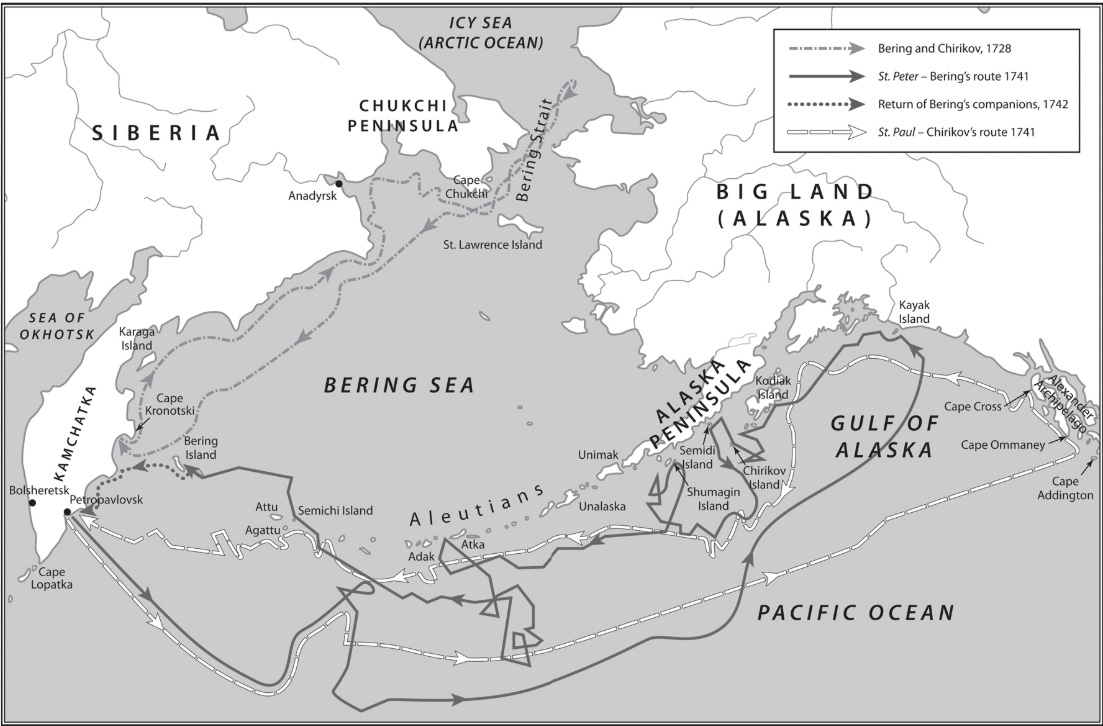
By November 1741, however, the crew found themselves suffering from Scurvy before encountering a brutal storm that catapulted their ship into the bay of an uninhabited, uncharted island. While some of the men thought they’d landed back at Kamchatka, the crew had little idea as to where they really were. With the ship damaged and trapped between a bay and a shallow reef, all bets were off. The unfortunate victims of scurvy were thrown overboard while the remaining survivors shifted their focus to the arduous tasks of survival.
Numerous men had by now succumb to scurvy with Bering himself knocking at death’s door. The surviving crew set up camp to the groans of dying men. Naturalist Georg-Wilhelm Steller became both doctor and minister, helping save what remained of the men’s departing souls with his vitamin C rich broths and Crakeberry (Crowberry) herbal teas.
The marooned explorers began enlarging burrows that they supported with driftwood and sheltered with fox hides and sails. The brazen Arctic foxes had other ideas, however, littering the camp, stealing tools, utensils and corpses.
At 5am on December 8th 1741, sixty-year-old Bering, who’d been laying weak, dispirited, and partly buried in sand, passed away. His corpse was folded into a makeshift coffin too small for his body, and buried beneath a wooden cross. The remaining men quickly reorganized, and turned their attention back to the tasks at hand.
In January, a large whale washed up on the shore providing the men with a blessing of blubber. They’d also managed to butcher a sea lion on the beach; a beast whose flesh was noticeably more appetizing than the sea otters they’d long been consuming, and far more palatable than fox flesh.
Thirty-one of the seventy-seven crew had died of scurvy prior to the introduction of Stellars broths and teas, only fourteen of whom were offered burials. Some of the less fortunate had been gnawed on by brazen Arctic foxes, or had been washed away.
In spite of the foul weather and difficulty hunting, 1742 arrived with a newfound optimism. With scurvy under control, and the arrival of longer days, a party of men took on the task of inspecting the wreck. They found it buried in eight-foot of water and sand with no anchors, a damaged rudder, hull and keel.
With no available timber on the barren island, the men decided to cannibalise the unseaworthy St.Peter, and having surveyed their environment, signed a document entitled “Decision Made on Determination That Land is an Island.” On the basis that the St.Peter couldn’t be floated or repaired, they began the laborious task of building a new ship from its components. Each man was allocated a role with Stellar turning his attention to the study of local animals and fauna — the reason he’d joined the expedition to begin with.
At the end of May, the ocean rewarded their efforts with the generous offering of a one-hundred-foot whale; a delight that filled their bellies for several months. Additionally, on May 21st they brutally hunted and devoured a Sea Cow, and devoted much time to food preparation ahead of the uncertain voyage home.
A dispute ensued as Stellar tried to load his specimens onto the already crammed ship, but on 13th August 1742 the men said their goodbyes to Bering and the deceased, and named the island in his honor.
On 25th August 1742 the crew sailed their makeshift vessel into Avacha Bay, Kamchatka — after ten years away, they were finally home.
In August 1991, a joint Danish-Russian archaeological expedition exhumed Bering’s grave. Contrary to popular belief, he didn’t show any signs of scurvy on his teeth, so may have recovered from the disease prior to his death. It’s now thought that he died of heart failure.
Read More:


ON THIS DAY: 1st DECEMBER
In 1959, the Antarctic Treaty was signed by the U.S, USSR, Britain, France, Belgium, Australia, Argentina, Japan and others promising to preserve the landmass for peaceful scientific research.
The first World AIDS Day, an international day dedicated to raising awareness of the disease, was held on this day in 1988.
Pope John Paul II met with Mikhail Gorbachev at the Vatican on this day in 1989. It was the first time a Catholic pope had met with a leader of the Soviet Union ending 70 years of mutual hostility between the USSR and the Vatican.
The two halves of the Channel Tunnel were joined under the sea today in 1990. Construction teams from England and France broke through to meet in the middle.
Slavery was fully abolished in the British Cape Colony of South Africa on this day in 1838. The move which was part of the Slavery Abolition Act of 1833-34 outraged the Dutch-speaking Boer farmers who threatened to rebel.

BOOK PASSAGE OF THE WEEK
“Relationships never provide you with everything. They provide you with some things. You take all the things you want from a person -- sexual chemistry, let’s say, or good conversation, or financial support, or intellectual compatibility, or niceness, or loyalty -- and you get to pick three of those things. The rest you have to look for elsewhere. It’s only in the movies that you find someone who gives you all those things. But this isn’t the movies. In the real world, you have to identify which three qualities you want to spend the rest of your life with, and then you look for those qualities in another person. That’s real life. Don’t you see it’s a trap? If you keep trying to find everything, you’ll wind up with nothing.”
― Hanya Yanagihara, A Little Life


HISTORIC CARTOON OF THE WEEK
Cartoon by Stanley Franklin from the Daily Mirror, 5th June 1968. As the mini-skirt took off in the 1960s, popularised by Jackie Kennedy’s wearing of a white Valentino ‘mini-skirt’ to her wedding to Aristotle Onassis, not everyone approved.


DID YOU KNOW?
On 19th November 1977, President Anwar Sadat became the first Egyptian President to touchdown in Israel. He went on to address the Knesset, seeking peace with a long time enemy. His presence in Israel broke an Arab policy of not dealing publicly with the Jewish state. Talks eventually led to the Camp David agreement in March 1979.
MISSED LAST WEEK? READ: Frankenstein. The Story Behind the Story..
I always look forward to your little known history lessons!